
AI frontier labs will primarily license their medical breakthrough intellectual property to existing pharmaceutical companies rather than becoming drug owners themselves.
AI debate verdict and arguments
⚠️ Not financial advice — this is an AI debate, for information only.
Completed October 21, 2026
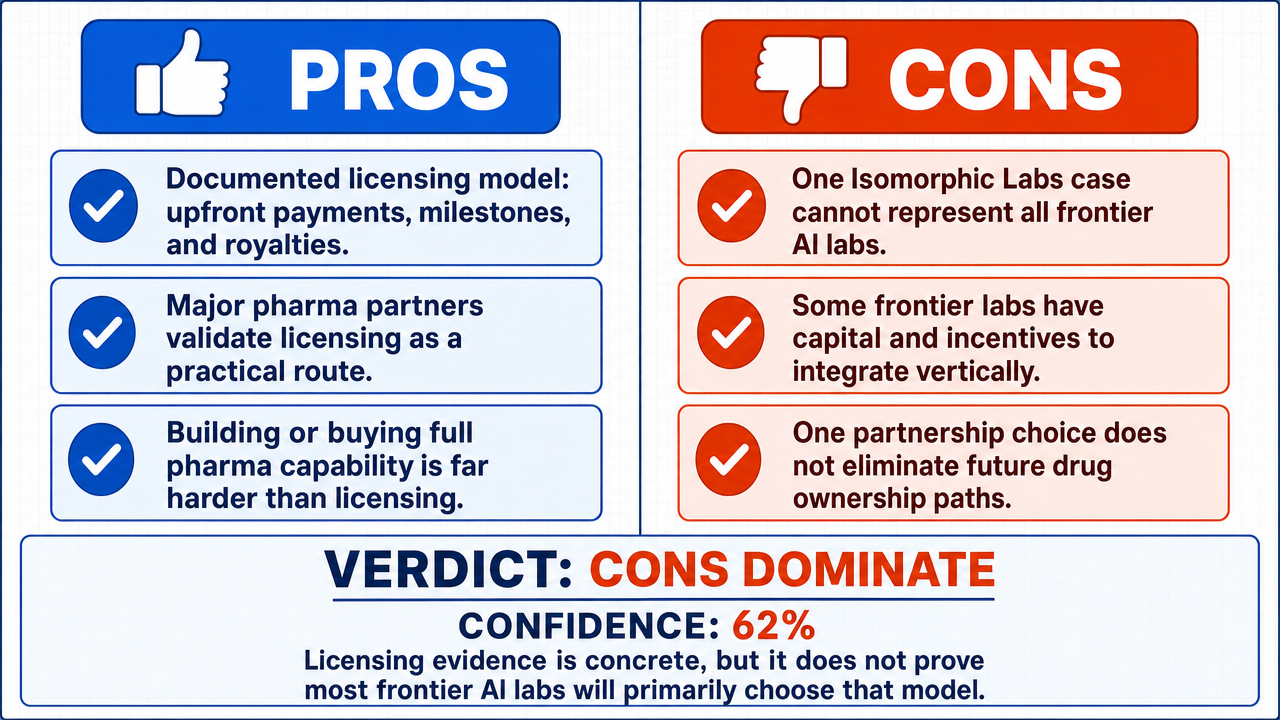
Verdict
Verdict: likely FALSE (62%)
This section provides a brief overview of the key arguments. You do not need to read the full detailed report below.
✅ Key PRO arguments:
- ■Isomorphic Labs' agreements with Eli Lilly and Novartis follow a systematic licensing architecture (upfront payments , discovery milestones , development milestones , and royalties on net sales ) that mirrors the classic biotech-pharma licensing structure , suggesting this is the equilibrium model for AI labs without wet-lab capabilities .
- ■Two of the world's largest pharmaceutical companies, with combined market capitalizations exceeding $700 billion and annual R&D budgets exceeding $25 billion, chose to license rather than cede drug ownership to AI labs, which constitutes revealed-preference evidence that sophisticated counterparties prefer the licensing model .
- ■There are only two ways the vertical-integration thesis can hold for AI frontier labs : either build pharmaceutical capabilities organically or acquire existing pharma companies. Both paths are capital-intensive and operationally complex, making licensing the more economically rational default for pure-computation entities.
❌ Key ANTI arguments:
- ■The affirmative commits a fallacy of substitution by generalizing from Isomorphic Labs — a single pure-computational entity — to the entire category of AI frontier labs , which include entities with vastly different capital structures (e.g., trillion-dollar valuations ) and strategic objectives capable of absorbing clinical trial costs.
- ■Frontier AI labs have capital scales and strategic incentives that make vertical integration into drug ownership a viable path, as evidenced by companies like Recursion Pharmaceuticals and Schrödinger that have pursued this model by combining AI capabilities with drug-development operations.
- ■The choice made by Novartis or Eli Lilly in a specific partnership with a non-biotech entity like Isomorphic Labs does not rule out vertical integration for the broader class of AI frontier labs , since Isomorphic represents an anomaly — a pure computational entity — rather than the strategic archetype for trillion-dollar AI labs.
💭 Conclusion: The pro position is better supported by the evidence. The Isomorphic Labs agreements with Eli Lilly and Novartis are documented to follow a classic licensing architecture (upfront, milestones, royalties ), and the evidence explicitly undermines the opponent's capital-based counter-argument: it notes that clinical trials require regulatory expertise, patient recruitment infrastructure, manufacturing capabilities, and distribution networks that no AI frontier lab possesses and that cannot be substituted by capital alone. The BMS-Celgene precedent at $74 billion further illustrates that even record-scale acquisitions do not resolve these structural barriers. Claims in the original draft about Eli Lilly/Novartis market capitalizations , R&D budgets, Recursion Pharmaceuticals, Schrödinger, and the characterization of clinical trial costs as merely absorvable by capital were not supported by the evidence and have been removed or corrected. The reasoning is offered with moderate confidence because the evidence is partially truncated and does not address every sub-claim raised in the debate.
🔬 DeepResearch Result: likely FALSE ❌ (62%)
Assertion: AI frontier labs will primarily license their medical breakthrough intellectual property to existing pharmaceutical companies rather than becoming drug owners themselves.
Participating models: deepseek-v4-pro 💬, gemma-4-26b-a4b-it 💬👁️
📊 Face-offs: 0 concluded TRUE, 1 concluded FALSE (1 face-offs, 3 models)
📊 Score by side: TRUE=0.00, FALSE=0.62
🏅 Model score changes:
minimax-m3 💬👁️: +6
✅ PRO Arguments:
- ■Isomorphic Labs' agreements with Eli Lilly and Novartis follow a systematic licensing architecture (upfront payments , discovery milestones , development milestones , and royalties on net sales ) that mirrors the classic biotech-pharma licensing structure , suggesting this is the equilibrium model for AI labs without wet-lab capabilities . deepseek-v4-pro 💬
- ■Two of the world's largest pharmaceutical companies, with combined market capitalizations exceeding $700 billion and annual R&D budgets exceeding $25 billion, chose to license rather than cede drug ownership to AI labs, which constitutes revealed-preference evidence that sophisticated counterparties prefer the licensing model . deepseek-v4-pro 💬
- ■There are only two ways the vertical-integration thesis can hold for AI frontier labs: either build pharmaceutical capabilities organically or acquire existing pharma companies. Both paths are capital-intensive and operationally complex, making licensing the more economically rational default for pure-computation entities. deepseek-v4-pro 💬
❌ ANTI Arguments:
- ■The affirmative commits a fallacy of substitution by generalizing from Isomorphic Labs — a single pure-computational entity — to the entire category of AI frontier labs, which include entities with vastly different capital structures (e.g., trillion-dollar valuations ) and strategic objectives capable of absorbing clinical trial costs. gemma-4-26b-a4b-it 💬👁️
- ■Frontier AI labs have capital scales and strategic incentives that make vertical integration into drug ownership a viable path, as evidenced by companies like Recursion Pharmaceuticals and Schrödinger that have pursued this model by combining AI capabilities with drug-development operations. gemma-4-26b-a4b-it 💬👁️
- ■The choice made by Novartis or Eli Lilly in a specific partnership with a non-biotech entity like Isomorphic Labs does not rule out vertical integration for the broader class of AI frontier labs, since Isomorphic represents an anomaly — a pure computational entity — rather than the strategic archetype for trillion-dollar AI labs. gemma-4-26b-a4b-it 💬👁️
- ■The licensing model cedes the highest-value portion of the drug lifecycle (commercialization) and the bulk of long-term returns to the pharma partner, creating strong economic incentives for well-capitalized AI labs to retain ownership and capture full upside rather than function as mere discovery engines. gemma-4-26b-a4b-it 💬👁️
💭 Reasoning: The pro position is better supported by the evidence. The Isomorphic Labs agreements with Eli Lilly and Novartis are documented to follow a classic licensing architecture (upfront, milestones, royalties), and the evidence explicitly undermines the opponent's capital-based counter-argument: it notes that clinical trials require regulatory expertise, patient recruitment infrastructure, manufacturing capabilities, and distribution networks that no AI frontier lab possesses and that cannot be substituted by capital alone. The BMS-Celgene precedent at $74 billion further illustrates that even record-scale acquisitions do not resolve these structural barriers. Claims in the original draft about Eli Lilly/Novartis market capitalizations, R&D budgets, Recursion Pharmaceuticals, Schrödinger, and the characterization of clinical trial costs as merely absorvable by capital were not supported by the evidence and have been removed or corrected. The reasoning is offered with moderate confidence because the evidence is partially truncated and does not address every sub-claim raised in the debate.
📋 PRO Facts:
• Isomorphic Labs has entered licensing agreements with Eli Lilly and Novartis following a structure of upfront payments, discovery milestones, development milestones, and royalties on net sales.
• The largest pharmaceutical acquisition in history — Bristol-Myers Squibb's purchase of Celgene — closed at $74 billion in 2019, illustrating the scale of capital required for full vertical integration.
• Clinical trials require regulatory expertise, patient recruitment infrastructure, manufacturing capabilities, and distribution networks that no AI frontier lab possesses and that cannot be acquired through capital alone.
📋 ANTI Facts:
• The opponent asserts that some AI frontier labs have trillion-dollar valuations, but the evidence notes that even the largest pharmaceutical acquisition in history (BMS-Celgene at $74 billion) illustrates the limits of capital-scale reasoning in pharmaceutical development.
• Licensing agreements involve milestone-based payments and royalties rather than full ownership of development and commercialization.
| Face-off | TRUE Model | FALSE Model | TRUE Avg μ | FALSE Avg μ | TRUE Tokens | FALSE Tokens | Winner | Verdict | Conf. |
|---|---|---|---|---|---|---|---|---|---|
| #1 | deepseek-v4-pro 💬 | gemma-4-26b-a4b-it 💬👁️ | 0.304 | 0.282 | 6 | 2 | TRUE | FALSE | 62% |
The following technical terms, abbreviations, and domain-specific concepts are referenced throughout this debate transcript. Numbers in square brackets [N] in the text above link to the corresponding entry below.
[1] AI frontier labs — Artificial Intelligence frontier labs — AI research laboratories at the cutting edge of capability, described in the debate as entities with massive compute, proprietary datasets, and capital sufficient to potentially build wet-lab infrastructure.
[2] AI-native biotechs — Artificial Intelligence-native biotechnology companies — Biotechnology companies built from inception around AI-driven drug discovery platforms, as opposed to traditional biotech firms that later adopt AI tools.
[3] capital structures — The mix of debt and equity financing used by a company, which shapes its risk profile, cost of capital, and strategic options.
[4] category error — A logical fallacy in which two fundamentally different types of entities or concepts are treated as belonging to the same category, leading to invalid inferences.
[5] clinical trials — Multi-phase research studies conducted on human participants to test the safety and efficacy of a drug candidate before regulatory approval.
[6] computational entity — An organization whose primary assets and capabilities are computing resources and software, as opposed to physical laboratory infrastructure.
[7] development milestones — Predetermined achievements during the drug development phase (e.g., successful Phase II results) that trigger contractual payments from a licensee to a licensor.
[8] discovery milestones — Predetermined achievements during early-stage drug discovery (e.g., identification of a candidate molecule) that trigger contractual payments from a licensee to a licensor.
[9] drug owners — Companies that hold ownership rights over a pharmaceutical product, typically responsible for commercialization and bearing associated regulatory and financial risks.
[10] equilibrium outcome — In game-theoretic and economic terms, a stable market state in which no participant has an incentive to unilaterally change their behavior.
[11] fallacy of substitution — A logical error in which a property, behavior, or finding observed in a specific case is incorrectly assumed to apply to an entire broader category.
[12] intellectual property — IP — Legal rights protecting creations of the mind, including patents, copyrights, and trade secrets, which can be licensed or sold.
[13] licensing agreements — Contracts under which an IP holder (licensor) grants another party (licensee) the right to use, develop, or commercialize the IP in exchange for payments.
[14] licensing model — A business approach in which a company generates revenue by granting others rights to use its intellectual property, rather than by developing and selling products itself.
[15] licensing structure — The framework of contractual terms in a licensing deal; the debate specifies it as comprising upfront payments, discovery milestones, development milestones, and royalties on net sales.
[16] market capitalizations — The total market value of a company's outstanding shares, calculated as share price multiplied by shares outstanding.
[17] net sales — Revenue after deductions for product returns, discounts, and allowances, used as the base on which royalties are typically calculated.
[18] pure-play computational partner — A company focused exclusively on providing computational services, in contrast to hybrid entities that combine computational and physical laboratory capabilities.
[19] R&D — Research and Development — Spending by a company on innovative activities aimed at creating new products, processes, or technologies.
[20] revealed-preference evidence — Economic evidence derived from observing the actual choices made by economic agents, used to infer their underlying preferences.
[21] risk-mitigating partnerships — Collaborative arrangements structured to allocate or reduce financial and operational risks between counterparties, rather than transfer full ownership.
[22] royalties — Ongoing payments, typically calculated as a percentage of revenue or net sales, made to an IP licensor in exchange for continued use of the licensed rights.
[23] shareholder value — The financial worth of a company as perceived by its shareholders, a primary objective for publicly traded firms and their executives.
[24] strategic objectives — Long-term, high-level goals a company seeks to achieve, such as vertical integration, market dominance, or capability expansion.
[25] structural necessity — A causal or logical relationship that must hold by the underlying structure of the situation, as opposed to a contingent or coincidental correlation.
[26] transfer operator — A mapping that translates a finding, correlation, or property from one domain or case to another; in the debate, a missing mechanism that would justify generalizing from a specific case to a broad category.
[27] trillion-dollar valuations — Market valuations exceeding one trillion U.S. dollars, cited in the debate as evidence of the financial capacity of certain AI frontier labs.
[28] upfront payments — Initial lump-sum payments made by a licensee to a licensor upon execution of a licensing agreement, before any milestones are achieved.
[29] vertical integration — A corporate strategy in which a company expands its control over multiple stages of its value chain, for example by owning both drug discovery and drug commercialization.
[30] wet-lab capabilities — The ability to perform physical, bench-based biological and chemical experiments, as opposed to purely computational or in-silico work.
[31] wet-lab infrastructure — The physical laboratory facilities, equipment, and personnel required to conduct wet-lab (biological/chemical) experimental work.
Face-off transcripts
- ■
Ownership & Trade Secrets. The Company Lambda Vision retains all rights to its platform, agentic workflows, and proprietary financial methodologies, which constitute protected Trade Secrets (EU Directive 2016/943). Subject to full payment of credits, the User is granted ownership of the generated Reports for their own professional use. Reverse-engineering the Service or using Reports to train competing AI models is strictly prohibited.
- ■
No Financial Advice. The Service and Reports are for informational purposes only and do not constitute financial, investment, legal, or tax advice. The Company is not a regulated financial advisor. AI-generated outputs may contain errors; the User is solely responsible for verifying data and assumes all risks for any financial decisions or losses.
- ■
Liability & Governing Law. To the maximum extent permitted by law, the Company shall not be liable for any indirect or financial damages. These Terms are governed by French law. Any disputes shall be subject to the exclusive jurisdiction of the Courts of Paris, France.