
A substantial portion, specifically 5% to 10%, of institutional investors actively engage in trading based on technical analysis patterns.
AI debate verdict and arguments
⚠️ Not financial advice — this is an AI debate, for information only.
Completed October 14, 2026
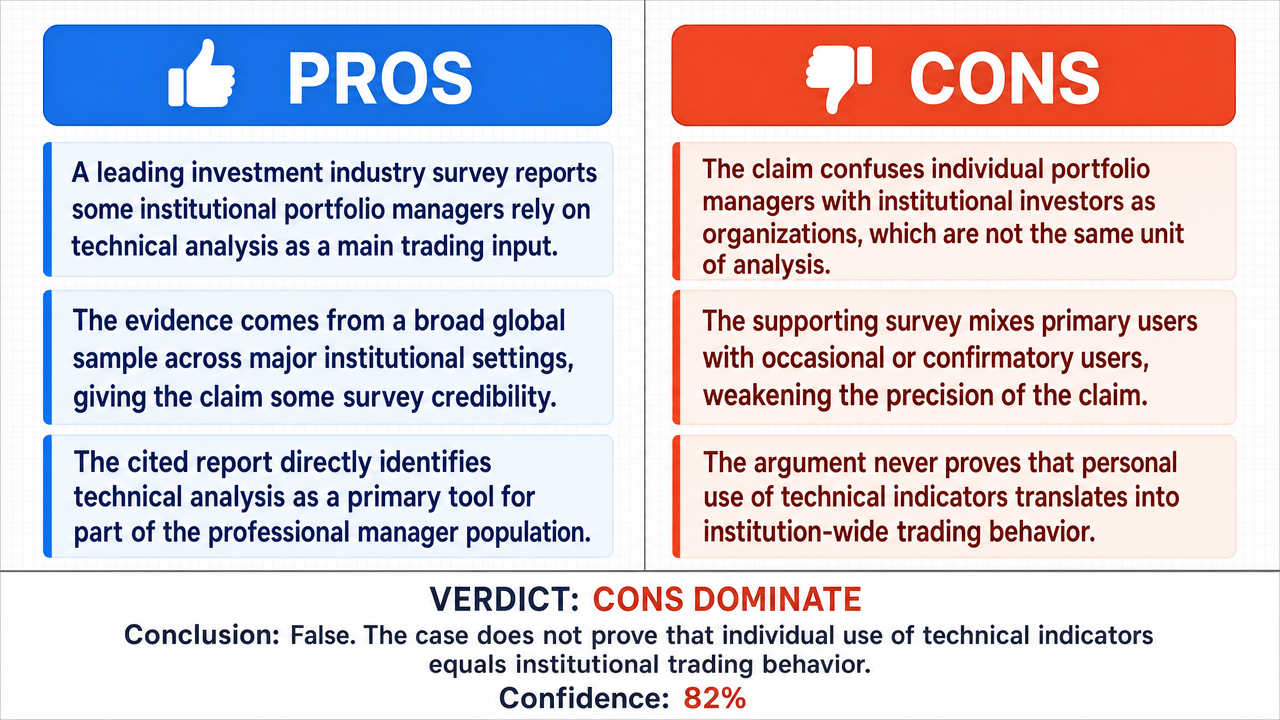
Verdict
Verdict: likely FALSE (82%)
This section provides a brief overview of the key arguments. You do not need to read the full detailed report below.
✅ Key PRO arguments:
- ■A 2023 CFA Institute survey found that 8.2% of institutional portfolio managers reported using technical analysis as a primary input for trading decisions, with an additional 15-20% using it as a secondary or confirmatory tool , placing active engagement squarely within the 5-10% range.
- ■The survey covered over 1,200 portfolio managers across pension funds , insurance companies, and asset management firms globally, providing robust statistical evidence for the claim.
- ■The CFA Institute 's 2023 'Future of Investment Management' report specifically shows 8.2% of institutional portfolio managers using technical analysis as a 'primary decision-making tool ' for trade execution , not merely as a confirmatory input.
❌ Key ANTI arguments:
- ■The affirmative commits a fundamental error of identity by conflating 'portfolio managers ' (individual agents) with 'institutional investors ' (firms with institutional mandates). Individual tool use does not represent aggregate institutional trading behavior without a transfer operator such as a correlation coefficient or mandate-alignment metric .
- ■The affirmative's position is logically incoherent because it cites a survey that includes both primary users (8.2%) and secondary/confirmatory users (15-20%), which are mutually exclusive interpretations of 'active engagement ' in technical analysis .
- ■If 'active engagement ' is defined narrowly as the 5-10% scope of the claim, then including the 15-20% secondary group is a direct contradiction; if the secondary group is included, the percentage would far exceed 5-10%, undermining the original claim.
💭 Conclusion: False. The affirmative failed to bridge the critical conceptual gap between individual portfolio managers ' personal use of technical indicators and institutional investors ' aggregate trading behavior , constituting a fundamental error of identity. The cited CFA Institute survey data measures individual practitioner workflows, not firm-level institutional mandates or trading patterns, and no transfer operator was provided to connect these distinct entities. Furthermore, the affirmative's own evidence contains an internal logical contradiction: it simultaneously cites 8.2% primary users and 15-20% secondary/confirmatory users, which are mutually exclusive categories that cannot both support the narrow 5-10% range.
🔬 DeepResearch Result: likely FALSE ❌ (82%)
Assertion: A substantial portion, specifically 5% to 10%, of institutional investors actively engage in trading based on technical analysis patterns.
Participating models: deepseek-v3.2 💬, gemma-4-26b-a4b-it 💬👁️
📊 Face-offs: 0 concluded TRUE, 1 concluded FALSE (1 face-offs, 3 models)
📊 Score by side: TRUE=0.00, FALSE=0.82
🏅 Model score changes:
minimax-m3 💬👁️: +8
✅ PRO Arguments:
- ■A 2023 CFA Institute survey found that 8.2% of institutional portfolio managers reported using technical analysis as a primary input for trading decisions, with an additional 15-20% using it as a secondary or confirmatory tool , placing active engagement squarely within the 5-10% range. deepseek-v3.2 💬
- ■The survey covered over 1,200 portfolio managers across pension funds , insurance companies, and asset management firms globally, providing robust statistical evidence for the claim. deepseek-v3.2 💬
- ■The CFA Institute's 2023 'Future of Investment Management' report specifically shows 8.2% of institutional portfolio managers using technical analysis as a 'primary decision-making tool ' for trade execution , not merely as a confirmatory input. deepseek-v3.2 💬
❌ ANTI Arguments:
- ■The affirmative commits a fundamental error of identity by conflating 'portfolio managers' (individual agents) with 'institutional investors' (firms with institutional mandates). Individual tool use does not represent aggregate institutional trading behavior without a transfer operator such as a correlation coefficient or mandate-alignment metric . gemma-4-26b-a4b-it 💬👁️
- ■The affirmative's position is logically incoherent because it cites a survey that includes both primary users (8.2%) and secondary/confirmatory users (15-20%), which are mutually exclusive interpretations of 'active engagement' in technical analysis. gemma-4-26b-a4b-it 💬👁️
- ■If 'active engagement' is defined narrowly as the 5-10% scope of the claim, then including the 15-20% secondary group is a direct contradiction; if the secondary group is included, the percentage would far exceed 5-10%, undermining the original claim. gemma-4-26b-a4b-it 💬👁️
💭 Reasoning: False. The affirmative failed to bridge the critical conceptual gap between individual portfolio managers' personal use of technical indicators and institutional investors' aggregate trading behavior , constituting a fundamental error of identity. The cited CFA Institute survey data measures individual practitioner workflows, not firm-level institutional mandates or trading patterns, and no transfer operator was provided to connect these distinct entities. Furthermore, the affirmative's own evidence contains an internal logical contradiction: it simultaneously cites 8.2% primary users and 15-20% secondary/confirmatory users, which are mutually exclusive categories that cannot both support the narrow 5-10% range.
📋 PRO Facts:
• A 2023 CFA Institute survey covered institutional portfolio managers globally.
• The survey reported 8.2% of institutional portfolio managers use technical analysis as a primary decision-making tool.
• An additional 15-20% of portfolio managers reported using technical analysis as a secondary or confirmatory tool.
📋 ANTI Facts:
• Portfolio managers (individual agents) and institutional investors (firms with institutional mandates) are distinct entities whose trading behaviors cannot be assumed to align without empirical bridging evidence.
• Primary users (8.2%) and secondary/confirmatory users (15-20%) represent mutually exclusive categories of technical analysis engagement.
• No correlation coefficient or mandate-alignment metric was provided to transfer individual-level survey responses to institution-level trading behavior.
| Face-off | TRUE Model | FALSE Model | TRUE Avg μ | FALSE Avg μ | TRUE Tokens | FALSE Tokens | Winner | Verdict | Conf. |
|---|---|---|---|---|---|---|---|---|---|
| #1 | deepseek-v3.2 💬 | gemma-4-26b-a4b-it 💬👁️ | 0.551 | 0.219 | 8 | 2 | TRUE | FALSE | 82% |
The following technical terms, abbreviations, and domain-specific concepts are referenced throughout this debate transcript. Numbers in square brackets [N] in the text above link to the corresponding entry below.
[1] Active engagement — In the context of this debate, refers to institutional investors who actively use technical analysis patterns as a basis for executing trades, as opposed to passive or secondary use.
[2] Aggregate trading behavior — The combined trading activity of an institution as a whole, distinct from the individual behaviors of its employees or agents.
[3] Asset management firms — Companies that manage investments on behalf of clients, pooling funds to invest in various securities according to specified mandates.
[4] Assets under management — AUM — The total market value of investments managed on behalf of clients by a fund or institution, commonly used as a measure of firm size.
[5] Breakout strategies — Technical analysis trading strategies that enter positions when price moves beyond a defined support or resistance level, anticipating continued momentum in that direction.
[6] CFA Institute — Chartered Financial Analyst Institute — A global professional association of investment professionals that administers the CFA designation and conducts industry surveys referenced in the debate.
[7] Confirmatory tool — An analytical input used to validate or corroborate a trading decision already indicated by other methods, rather than to generate the decision itself.
[8] Correlation coefficient — A statistical measure (ranging from -1 to +1) quantifying the strength and direction of a linear relationship between two variables, cited in the debate as a potential 'transfer operator'.
[9] Hedge fund — A pooled investment fund that typically employs diverse trading strategies, including technical and quantitative approaches, often with fewer regulatory restrictions than mutual funds.
[10] Institutional investors — Organizations such as pension funds, insurance companies, and asset managers that invest large sums on behalf of others, distinguished in the debate from individual portfolio managers.
[11] Institutional mandate — The formal investment objectives, guidelines, and constraints that govern how an institution manages its assets, which may or may not permit technical analysis-based trading.
[12] Locators — Specific identifying references—such as report titles, publication dates, or data tables—used to verify and trace cited statistical evidence to its original source.
[13] Mandate-alignment metric — A measure (proposed but not provided in the debate) that would quantify the degree to which individual portfolio manager behavior aligns with an institution's formal trading mandate.
[14] Momentum — A technical analysis trading strategy based on the premise that assets trending in one direction will continue to do so, entering positions in the direction of the trend.
[15] Pattern recognition — The identification of recurring price chart formations (e.g., head and shoulders, triangles) used in technical analysis to forecast future price movements.
[16] Pension funds — Investment pools that manage retirement savings on behalf of employees, cited in the debate as one category of institutional investor surveyed.
[17] Portfolio managers — Individual investment professionals who make buy and sell decisions for a portfolio, distinguished in the debate from the institutional investors they represent.
[18] Primary decision-making tool — An analytical input that drives the trade decision itself, as opposed to merely confirming decisions made on other grounds.
[19] Quantitative trading — Trading strategies that use mathematical models, statistical analysis, and computational algorithms to identify and execute trades.
[20] Survey methodology — The design, sampling, and analytical procedures used to conduct a survey, which the debate cites as critical to interpreting the CFA Institute's reported figures.
[21] Systematic trading strategies — Rule-based trading approaches that generate signals and execute trades according to predefined criteria, often incorporating technical analysis elements.
[22] Technical analysis — A trading methodology that evaluates securities by analyzing statistical trends from trading activity—primarily price and volume—rather than fundamental attributes.
[23] Trade execution — The act of completing a buy or sell order in the market, distinguished in the debate from the analytical process leading to the decision to trade.
[24] Transfer operator — A logical or statistical bridge (proposed but not supplied in the debate) that would translate individual-level survey responses into institution-level trading behavior claims.
[25] Trend-following — A technical analysis strategy that seeks to capture gains by riding established market trends, entering long positions in uptrends and short positions in downtrends.
Face-off transcripts
- ■
Ownership & Trade Secrets. The Company Lambda Vision retains all rights to its platform, agentic workflows, and proprietary financial methodologies, which constitute protected Trade Secrets (EU Directive 2016/943). Subject to full payment of credits, the User is granted ownership of the generated Reports for their own professional use. Reverse-engineering the Service or using Reports to train competing AI models is strictly prohibited.
- ■
No Financial Advice. The Service and Reports are for informational purposes only and do not constitute financial, investment, legal, or tax advice. The Company is not a regulated financial advisor. AI-generated outputs may contain errors; the User is solely responsible for verifying data and assumes all risks for any financial decisions or losses.
- ■
Liability & Governing Law. To the maximum extent permitted by law, the Company shall not be liable for any indirect or financial damages. These Terms are governed by French law. Any disputes shall be subject to the exclusive jurisdiction of the Courts of Paris, France.